
Starting a US business from overseas is entirely legal and accessible without holding American citizenship or residency. Non-resident entrepreneurs can establish and operate an American commercial entity while managing daily operations entirely from abroad. Doing so correctly requires adhering to state registration rules, federal tax reporting procedures, and interstate sales tax thresholds.
Can you start a US company as a non-resident?
You can form and own a business in the United States without being an American citizen, holding permanent residency, or maintaining a physical street address. Non-residents routinely set up limited liability companies or corporations by appointing an in-state registered agent to receive formal legal documents and official state notices on their behalf.
According to guidance from the Delaware Division of Corporations and the Small Business Administration, foreign nationals may form either a C-Corporation (C-Corp) or a Limited Liability Company (LLC). You do not need to visit the United States to complete your formation paperwork, nor do you need an American domestic postal address to register the enterprise.
State law dictates that any corporate entity operating without a physical street address in its state of formation must designate an official Registered Agent. Under the Delaware Registered Agent requirements, this agent must possess a physical street address within the jurisdiction and remain available during regular business hours to receive service of process, official correspondence, and annual state notices.
Entrepreneurs often choose formation friendly states such as Delaware. However, formation in one state does not give you unlimited permission to operate physical facilities anywhere in the nation. If your company leases property, stores inventory in third-party warehouses, or employs workers in other jurisdictions, you trigger nexus in those states. In those situations, you must submit a "foreign qualification" filing and pay administrative registration fees in each additional state where operations take place, as outlined by the Small Business Administration.
Carefully selecting the right business structure prevents expensive restructuring down the line. A C-Corporation is often chosen if you plan to seek venture capital or issue stock, while an LLC provides structural simplicity. At FXN Holdings, our platform setup approach ensures that any market entry matches local company and tax obligations before public launch.
How do non-residents get an IRS Employer Identification Number?
Non-resident founders obtain an Employer Identification Number from the Internal Revenue Service at no cost by submitting Form SS-4 by fax, mail, or international telephone. Because the IRS online application requires a Social Security Number or Individual Taxpayer Identification Number, foreign applicants must write "Foreign" or "N/A" on line 7b instead.

A federal Employer Identification Number (EIN) is a unique nine-digit tax identification number issued by the Internal Revenue Service (IRS). Every American corporate entity requires an EIN to open an enterprise bank account, hire personnel, handle merchant payments, and satisfy annual tax reporting requirements. The IRS Employer Identification Number portal notes that there is no government filing fee charged to issue an EIN.
Domestic founders with a Social Security Number (SSN) or Individual Taxpayer Identification Number (ITIN) can use an automated portal on the IRS website. However, foreign founders without an SSN or ITIN cannot use this web portal. As specified in the IRS Form SS-4 instructions, overseas applicants must complete paper Form SS-4.
On line 7b of Form SS-4, where the form requests the responsible party's SSN or ITIN, enter "Foreign" or "N/A" only if the responsible party does not have, and is ineligible to obtain, an SSN or ITIN. Lacking a number alone does not establish eligibility for this treatment.
Once completed and signed, you can submit Form SS-4 using three approved international methods:
- Fax: You transmit the completed form to the dedicated IRS international fax line.
- Telephone: International applicants may contact the IRS international tax line directly. An authorised representative or corporate officer answers the agent's questions and reads through the Form SS-4 details over the phone.
- Mail: You post Form SS-4 to the designated IRS internal operations centre. This postal route takes several weeks depending on international postage transit.
Securing your EIN establishes your corporate identity with federal authorities and enables commercial providers to verify your business credentials.
What federal tax filings and FinCEN rules apply to foreign owners?
Foreign-owned companies face specific federal filing rules: corporations pay a flat twenty-one percent federal tax rate on Form 1120, while foreign-owned single-member LLCs must file Form 5472 with a pro-forma Form 1120. Foreign entities registering directly in a US state or tribal jurisdiction may also have FinCEN reporting duties if they meet the reporting-company definition and do not qualify for an exemption; US-created entities are exempt.
Tax compliance depends entirely on how your legal structure is classified by the federal government. Standard American C-Corporations pay a flat federal corporate income tax rate of 21% on net taxable profits, reported annually on IRS Form 1120.
Foreign entrepreneurs frequently establish a single-member LLC, believing it requires little administrative maintenance. However, under Section 6038A of the Internal Revenue Code, a single-member LLC owned 100% by a non-resident alien is classified as a "foreign-owned disregarded entity." While the entity does not pay federal corporate income tax as a separate corporation, the IRS treats it as a domestic corporation strictly for informational reporting purposes.
Under these rules, the foreign-owned single-member LLC must file an informational pro-forma Form 1120 with an attached Form 5472. This disclosure documents all reportable transactions occurring between the domestic LLC and its foreign owner or associated related entities, including capital injections, cash withdrawals, management fees, interest, or borrowed funds. The filing deadline corresponds with standard corporate deadlines—generally April 15 for calendar-year businesses, or October 15 if you secure an extension via Form 7004.
Overlooking Form 5472 carries severe financial consequences. Under the IRS Form 5472 instructions, failing to file Form 5472 on time or neglecting to maintain required accounting records triggers a statutory penalty of $25,000 per form for each tax year. If the failure continues beyond 90 days after the IRS issues an official notice of failure, an additional $25,000 continuation penalty is charged for every subsequent 30-day period, with no upper statutory limit.
Beyond the IRS, non-US business groups should check the current FinCEN beneficial ownership reporting guidance. Entities created in the United States are exempt from BOI reporting. Entities formed under foreign law and registered to do business in a US state or tribal jurisdiction must assess whether they meet the reporting-company definition and qualify for an exemption. For non-exempt foreign reporting companies registered on or after 26 March 2025, the initial report is due within 30 calendar days of effective-registration notice. These companies do not report beneficial ownership information for US persons.
How do state franchise taxes and economic nexus sales taxes work?
States impose recurring franchise taxes and remote sales tax obligations independent of federal corporate taxes. For example, Delaware collects franchise taxes annually by specific deadlines, while remote sellers must register and collect sales tax once shipments surpass state economic nexus benchmarks, such as one hundred thousand dollars or five hundred thousand dollars.
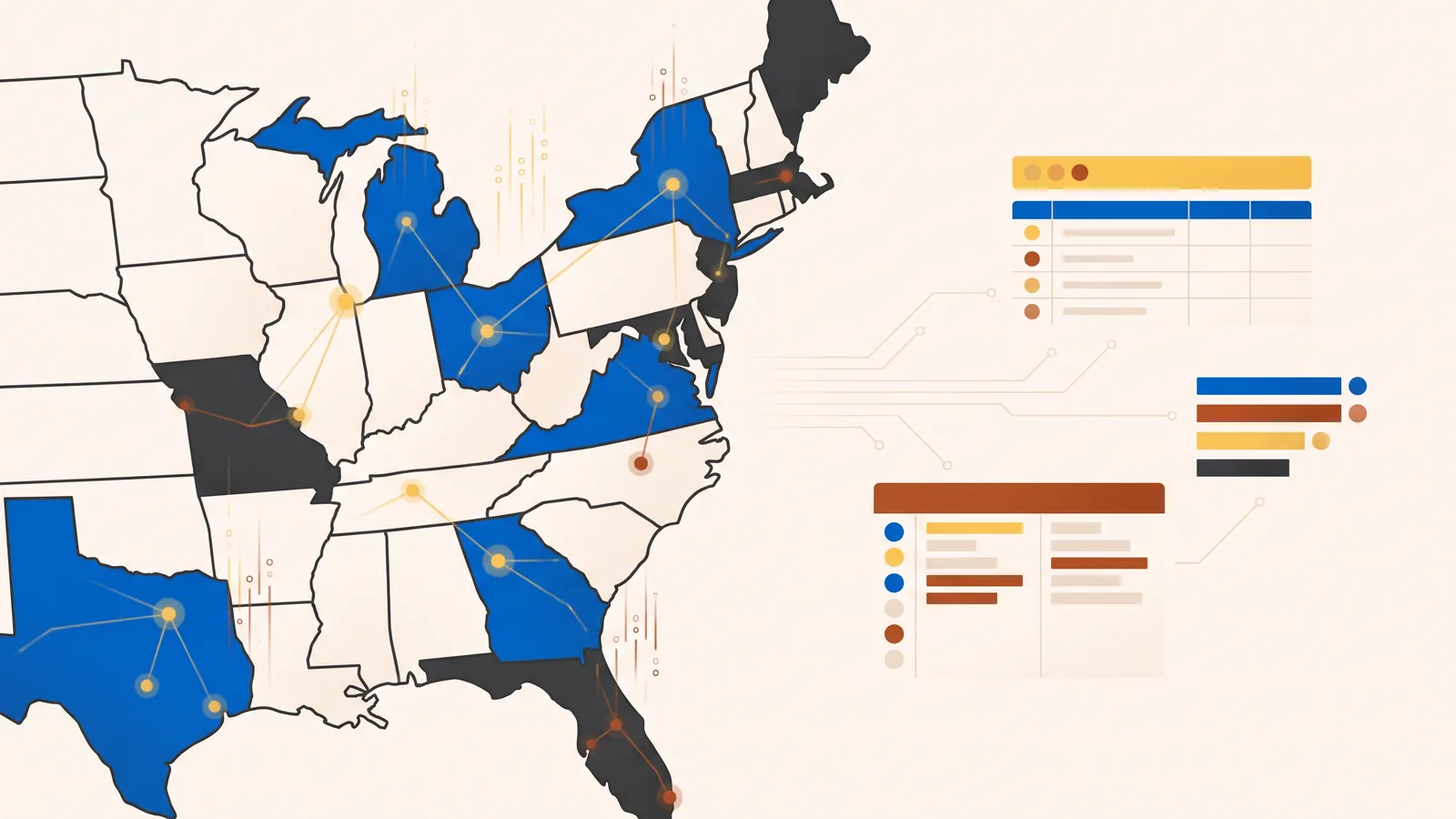
State-level business taxes apply regardless of your federal income tax posture. Delaware requires domestic corporations to submit an annual report and pay an annual franchise tax by March 1 every year. The minimum tax is $175 when calculated under the Authorized Shares Method, or $400 under the Assumed Par Value Capital Method, alongside a mandatory $50 filing fee. Missing the March 1 statutory deadline incurs an automatic penalty of $200 plus monthly interest assessed at 1.5% on all outstanding balances.
For Delaware LLCs, the administrative burden is slightly different. LLCs must pay an annual flat tax by June 1. While Delaware LLCs do not need to draft or lodge a narrative annual report, paying this flat tax on schedule is mandatory to maintain lawful good standing with the state government.
For businesses selling tangible items into the US—such as cross-border e-commerce brands—state sales tax represents another vital consideration. In the past, companies only collected sales tax in states where they had a physical storefront, office, or employee. Today, states enforce "economic nexus" rules for remote sellers.
Under economic nexus laws, an overseas or remote business becomes liable for sales tax registration, collection, and remittance once its sales cross specific revenue or transaction thresholds in a target state, even with zero physical footprint there. For instance, many states trigger registration requirements once an out-of-state retailer reaches $100,000 in gross sales or completes 200 individual transactions into the state within a calendar year. Some states set different limits, so check each state's revenue department.
When we deploy platforms in our digital venture portfolio, our team configures local trading and tax rules before launching to remote buyers.
What are the rules for travelling to the US to manage your business?
Business owners travelling to the United States under the Visa Waiver Program or on a B-1 visa can only conduct temporary activities like negotiating contracts or attending meetings. They are strictly prohibited from performing day-to-day labor or operational management while in the country, which requires specific work visas like an E-2 or L-1.
Owning an American corporation does not confer an automatic right to enter, live in, or work within the United States. Foreign founders frequently make the mistake of assuming that corporate incorporation grants personal immigration clearance.
When travelling to the US on a standard B-1 Business Visitor visa or using the Visa Waiver Program via an Electronic System for Travel Authorization (ESTA), permissible business activities are strictly constrained. You may:
- Attend executive shareholder meetings or industry conferences.
- Negotiate and execute commercial agreements with corporate partners.
- Consult with legal, financial, or accounting advisors.
- Inspect and evaluate potential commercial real estate for purchase or lease.
You cannot perform productive employment or day-to-day skilled or unskilled operational labour while physically present on US soil under visitor status. You may not write client code, process warehouse inventory, manage store shifts, or collect local operational wages while in visitor status.
To live in the US and actively manage daily domestic operations, business owners must apply for an employment-authorised visa category. Qualifying founders often explore the E-2 Treaty Investor visa (open to nationals of countries maintaining qualifying treaties of commerce with the United States) or an L-1 Intracompany Transferee visa (for owners transferring executives from an established foreign business to an affiliated US office).
If you run your venture remotely from your home country, you do not need an American work visa. You can run company infrastructure, update websites, and supervise strategic operations while living abroad, provided you observe visa boundaries whenever you enter the United States for short business trips.
How do you maintain ongoing compliance while operating remotely?
Operating an American enterprise from overseas requires keeping distinct corporate records, submitting annual state filings before statutory deadlines, and observing sales tax thresholds across every jurisdiction you supply. Separating international governance from domestic operational presence preserves corporate standing and ensures that your enterprise remains fully compliant with federal and state regulations year after year.
Managing an overseas venture demands continuous administrative discipline. You must maintain clear accounting records to substantiate the numbers reported on your federal filings, particularly when preparing Form 5472 and Form 1120. Tracking every cross-border capital transfer prevents severe statutory penalties from the IRS.
State deadlines require equal vigilance. Ensure that your registered agent service remains active so you never miss formal correspondence from state authorities. Diarise filing deadlines like Delaware's March 1 corporate franchise tax date and June 1 LLC payment date to avoid automatic late fines.
If you operate an e-commerce or retail business, monitor your transaction counts and turnover state by state. The moment your business reaches a state's economic nexus threshold, register for that state's sales tax permit and configure your checkout software to collect and remit the appropriate tax rates.
At FXN Holdings, we build and maintain platforms designed to satisfy local laws across multi-region markets. Whether reviewing open-source technology frameworks on our technology overview page or establishing direct trading channels, systematic preparation is what ensures long-term viability. If you are exploring a commercial project or cross-border venture, feel free to contact our team to discuss opportunities.
Official sources (checked 9 October 2026)
- corp.delaware.gov: Faqs
- sba.gov: Launch your business
- corp.delaware.gov: Faqs regarding registered agents
- sba.gov: Grow your business
- irs.gov: Get an employer identification number
- irs.gov: Iss4
- FinCEN: current beneficial ownership reporting guidance
- irs.gov: I5472
This guide is general information, not legal or tax advice. Rules change and can differ by state or country, so confirm with the official source or a qualified adviser before you act.
Found an error? Send a correction to FXN Holdings.